Project Work
Country-specific ecological macroeconomic modelling
As part of the DEFINE (Dynamic Ecosystem-FINance-Economy) team I have worked on the development of country specific DEFINE models, including the DEFINE-UK model and the DEFINE-ALBANIA model which is under development. This has involved combining the ecological stock-flow consistent (SFC) modelling approach of DEFINE, with country-specific empirical modelling approaches. These models therefore incorporate interactions between the macroeconomy, finance and ecological variables while also accurately reflecting the accounting structure of the country being modelled.
DEFINE-UK
DEFINE-UK is used to produce scenarios for the UK macrofinancial system and its ecological impacts under different environmental policies. The model further provides a blueprint for how the DEFINE methodology can be applied to a specific country for the evaluation of national environmental policies.
The figure below summarises the structure of the DEFINE-UK model.
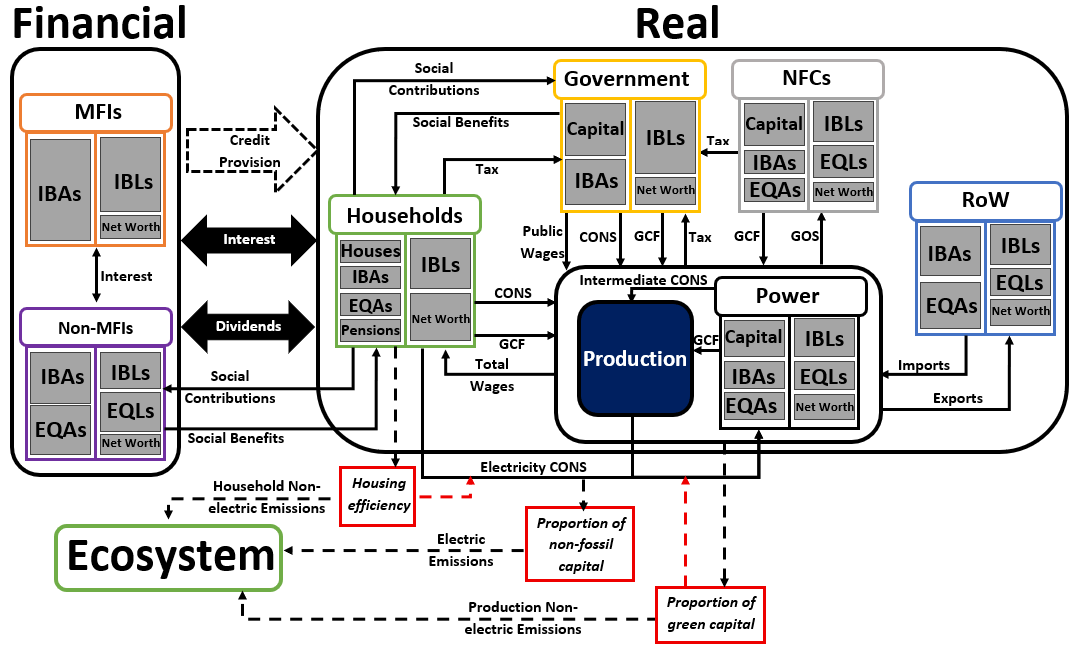
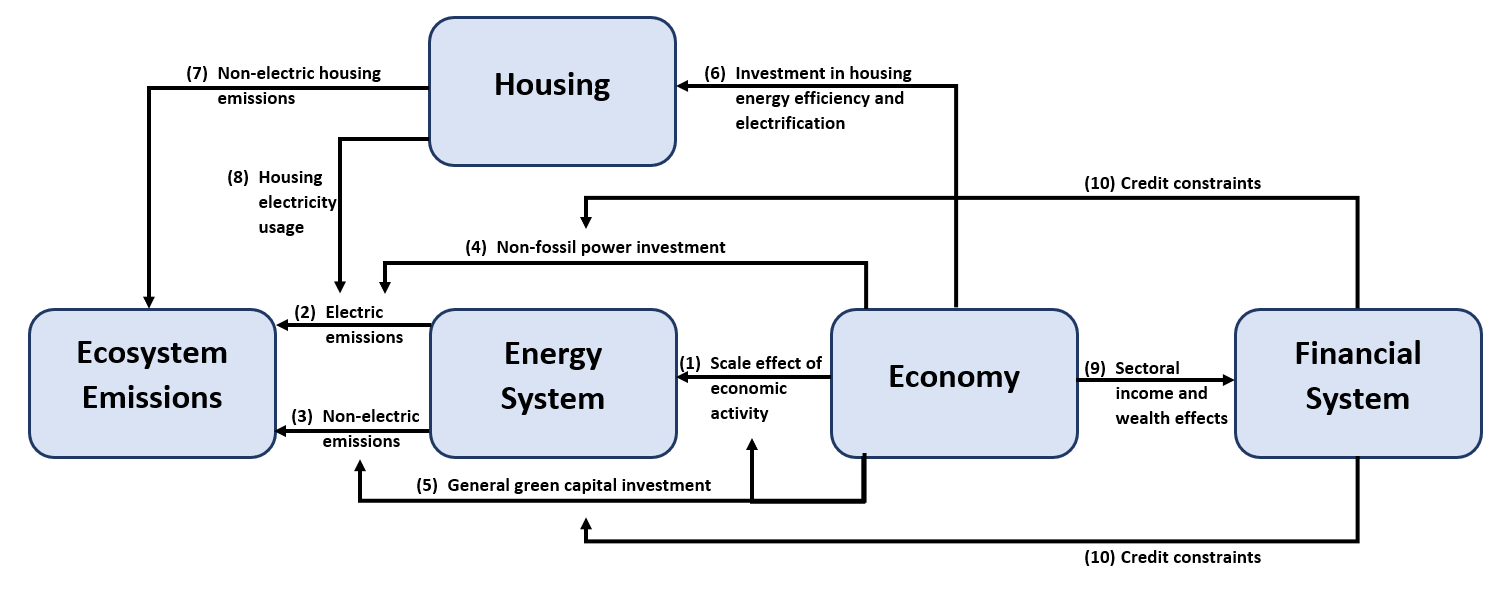
The key channels which integrate the macroeconomic, financial and ecological systems are described in the graph below:
The channels are:
The scale effect of economic activity: Representing how energy use is directly related to economic activity in the model. All else being equal, if there is more economic activity, then energy use will increase.
The scale effect of energy use on electric emissions: Increases energy use leads to an increase in the electricity use and emissions from electricity generation.
The scale effect of energy use on non-electric emissions: Increases energy use leads to an increase in non-electric energy use and emissions from non-electric energy generation.
Non-fossil power investment: Reduces the emissions from electricity generation by building non-fossil fuel based electricity generation capital.
General green investment: This investment broadly captures investment in green capital, such as energy efficient buildings, electric appliances, and energy efficient machinery. This increases the stock of green capital relative to conventional capital. This in turn leads to a moderate reduction in the intensity of emissions from the use of non-fossil fuel energy, energy intensity and an increase in the electricity share of energy use. All effects together serve to dampen channels (1)-(3).
Investment in energy efficiency and home electrification: This includes investment in housing energy efficiency and electrification improvements.
Non-electric housing emissions: Housing emissions are not driven by economic activity but are instead primarily impacted by the quality of the housing stock with better energy efficiency and electrification of houses reducing these emissions.
Housing electricity usage: With home improvements leading to greater electrification of homes this will increase electric emissions unless it is combined with an expansion of non-fossil power capital. Nevertheless, the net impact on emissions of these efficiency improvements is likely to be an overall reduction in emissions.
The effects of sectoral income and wealth: Will affect the sectors' debt-service ratios while also directly affecting the financial position of banks and other financial corporations. These effects will impact the perceived credit-worthiness of these sectors.
Credit constraints: Based on the perceived creditworthiness of the sector carrying out investments, banks will ration the availability of credit. This will constrain all types of investment in the model, including green investments.